Dear Breakfast at Epiphanies,
I’m writing because it seems like you’ve an idea about what neurodivergent life is like. I have just moved from the southern hemisphere to the UK, something that I’ve been dreaming about doing for nearly 20 years.
The reality is so different, and so much harder than I thought it was going to be though. I knew it was going to be cold, but I’m struggling with the lived reality of it being cold. I knew I was going to be living in shared accommodation, but I’m struggling with the lived reality of living in shared accommodation. I knew I would have to find a job, but the precarious casual work I have isn’t quite paying the bills, and it’s so exhausting – I don’t have time or headspace to find anything else.
I moved here for theatre opportunities, but they’re proving difficult to come by, and everything is planned so far in the future that it feels like it’ll never be here now.
I’m diagnosed AuDHD, and had my providers and meds worked out at home, but trying to get the same things here is proving a monumental challenge.
There’s also family drama at home, and it’s impacting upon my ability to live in the moment here.
I thought this was my dream, but it’s turning into a nightmare.
What can I do?
Neurodivergent Nomad
Dear Neurodivergent Nomad,
Thank you so much for sharing and opening up about your struggles. Moving to the other side of the world is really tough – it’s up in the top 3 most stressful life events – so know that it is hard, and that’s before you’ve got so many complicating factors.
Moving across the other side of the world is a really big deal, and it takes a toll on every aspect of your life! It’s incredibly difficult when there are that many things that change all at once, and you’re so far away from any support network and anything that is familiar. (Read more here)
Having moved countries several times now, I agree that it’s astonishing the amount of things that can be different from the massive to the minutia – even in another English-speaking country.
It doesn’t seem to matter where you move, people who have just arrived are at a disadvantage in many ways, and the only cure for that is time, grit and experience – and a lucky break.
The better off you were in terms of support systems, career, living situation and financial situation, the starker the contrast when you move abroad. It really is like starting over, but with no safety net, and it is not for the faint of heart.
The worst part is your support network back home often have no idea of the myriad differences and conflicting emotions that this culture shock can cause. In the first few months, there’s no new social network that you can rely on, and so often you end up looking in the mirror and soul searching. It can be a lonely, uncomfortable time until you find some framily – friends that you choose as family. It will never be the same as being at home, and the relationships will always require you to explain yourself a little more than at home, but they can be amazing friendships that span continents, decades, and difficulties.
It can be incredibly hard trying to explain to the people who love you that something that you’ve wanted for so long is causing you so many difficulties. The automatic problem-solving response of many listening will be ‘so just come home’ but if you can persevere through the job-searching community-finding hobby-taking-up doctor-finding visa-processing life-admin-elephant-eating-one-bite-at-a-time, lonely, underemployed-so-poor stage, then the next stage is what makes living abroad really interesting.
When you get past that stage do let me know. 😉 I jest. Mostly.
7 years in and 2 countries later, it is easier to sit in the ‘suck’ of those elements, but living away from your native country does definitely come with harder parts.
It will be like a cha-cha – two steps forward, one step back. A gradual diluting of the suckiness. You will always miss things, people, food, and ways of doing things from home. Over time, you’ll find places, people, food and things that you appreciate in a different way to home.
Or you won’t. Then you’ll have loads of things to look forward to about going home.
Different Climate
Neurodivergent Nomad, you mentioned that you’re struggling with living in a different climate. Your body will eventually adjust, but until then here are some ideas of how to create warmth:
- Do some gentle exercise – yoga, tai chi, online exercise apps or youtube videos to help keep warm from movement
- Drink hot drinks
- Get hot water bottles – these stay warmer and are cheaper to fill/run than heaters
- Indulge in local amenities – saunas at the local pool, heaters at the local library or coffee shop are a good way to stay warm while not being at home.
- Find somewhere like a YMCA to hang out
- Getting a second job may help with warmth and also income
- Invest in merino blend clothing – quick drying and warm. (Be sure to handwash to avoid shrinkage and other wool-related issues – I wash mine in the shower)
- Learn to use layers – wool close to the skin if you can, then layer up.
- I cannot recommend fleece lined leggings/ pants highly enough. They’re a game changer.
Shared accommodation
Sharing a house with other adults who have no incentive to like you is horrid. This is again contrasted by coming from a situation where you haven’t needed to do that.
There are some ways to make shared accommodation suck less. Finding like minded people to share with is I think the first point – hard to do when you’re new to town and you’re in no position to negotiate.
When you’ve found somewhere to live, a charm offensive goes a long way. Go out of your way to be kind, build relationships, and do more than is needed.
Expecting that others are going to share your communication style and way of thinking is setting everyone up to fail. You’ve said that you are AuDHD, and that you like boundaries, rules and structure. Most other humans will not understand what that means for you when you say that, so you will need to ask questions to elicit the structure and rules out of them that they do innately have but are not good at articulating.
There will be a lot of unknown unknowns for you and for them, so bridge that with as much grace and compassion as you can muster.
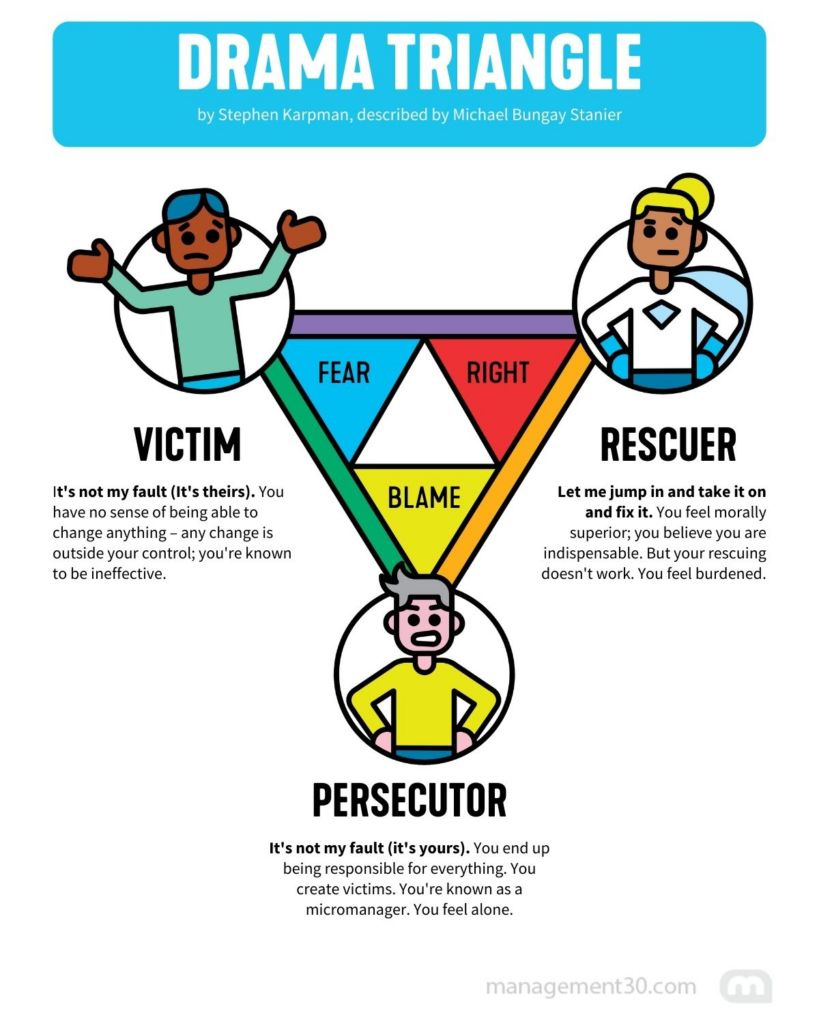
Be aware of the ‘drama triangle’ which can easily occur when someone is playing the role of persecutor – accusing others. Many people then default to playing the victim – complaining with no intention of actually solving the problem. When someone else is playing the victim, others are likely to come to their aid as the rescuer – offering solutions, or acting to solve the problem.
The Drama Triangle often originates from unmet emotional needs, a lack of assertiveness or self-awareness, and poor communication skills. This dynamic quickly leads to a toxic relationship, so the quickest way to circumvent the triangle is to nip things in the bud before there’s time to fester. It helps to distance yourself from your thoughts, and identify your defensive responses, accusing others, playing the victim or trying to help others by offering solutions that they need to come up with by themselves (I’m aware, but I’m writing this anyway…). Ted talk to explain
Default to your most compassionate interpretation. Where possible, assume incompetence or oversight in others rather than malice. Even if it’s not true, the way you approach people will be kinder and softer, and less likely to lead to conflict. Imagine the kindest possible interpretation of what people could’ve meant, and go from there. Everyone is uneasy with conflict and so is likely to do or say things that will make a situation worse, but if you can assume their intentions are good, it can keep things from escalating.
It sounds crazy, but go above and beyond to minimise yourself and the footprint you take up in the share house – at least initially. They will have a way of doing things, and the last thing you want is to create a narrative in your housemates’ heads of ‘x is always doing y’ because it can be really difficult to come back from that.
Ask a lot of specific questions early to prevent these narratives from occurring – for instance:
- ‘How do you dry your clothes when it’s so cold?’
- ‘What do you think a reasonable amount of time to have heaters on is?’
- ‘How do you manage to stay warm when you’re at home?’
Where possible, try to create positive bonding experiences together to counteract the annoying aspects of being in each others’ spaces all the time. Maybe you can play board games or dine together? Karaoke? Even tea can be a nice way to bond and foster goodwill.
Finding A Job
Finding suitable employment when you’re moving to another country is really hard. Jobs that are advertised are usually available for only a few reasons – someone else has left the job, or there’s growth in the company and they’ve created a new position. Ideally, you want to find the latter.
You mentioned opportunities in theatre – I’m sure paid opportunities are really hard to come by so in the meantime, you’ll need to find something that pays enough to live on. Without a profession, I found that it was often minimum wage jobs where one could start, which makes options very limited.
My first year in Ireland, I tried to find something outside of teaching that would pay me enough to be able to live and travel. I went from minimum wage as a waitress to slightly more working at a creche, back to minimum wage working at a summer school English language programme, to nannying, back to teaching. It took 6 months before I found a nannying gig that would adequately pay the bills, and it sucked in the meantime. Even with two incomes, we were only just able to pay the bills for our own apartment in Dublin. Working precarious jobs where you’re not entitled to leave, holiday, sick pay, or flexible working conditions adds stress.
You’ve secured some work, but it’s not quite paying the bills. You’ve a couple of options. Find another full time job to replace the current one or get a second job. A side-hustle can supplement income well. Consider from some of the following:
- Babysitting
- Tutoring / Kip McGrath / Coderdojo
- Evening job
- Onlyfans? 😉
- Editing services for writers
- Learn to do a walking tour and earn tips
- Monetise a hobby
When I was in Ireland, I did weekend work at coderdojo, teaching kids how to code for a bit, did some babysitting, worked in a boardgame shop, and did some online tutoring.
I’m now doing in-person tutoring, and considering finding some massage clients to practice massage skills on.
Those are my ideas which are tailored to my skills and talents, but I’m sure you can come up with some of your own.
I found that cash in hand jobs were better as when I had a second official job, I got penalised on tax very harshly to the point that it became a hobby rather than a profitable venture.
AuDHD Support
Everything is exponentially harder when there is a neurodivergence involved. Whether it be from limited executive functioning, social bandwidth, sensory overstimulation, lack of access to support, medications or any number of other things, the AuDHD neurotype can hinder as much as it can help in some aspects. Society isn’t built for people easily crossing borders, so this will be an excellent opportunity for you to grow in finding and creating your own coping strategies.
The UK is one of the best places in the world if you are neurodivergent. There is a culture of inclusion (at least in word, if not in deed), there are laws protecting people who are neurodivergent, and there are loads of organisations that can help with information, support, and other things. Some are listed here:
AuDHD support in London
https://www.addiss.co.uk/getting-support/supporting-people-with-adhd
https://www.londonautismgroupcharity.org/what-we-do
https://www.nhs.uk/conditions/autism/support
https://www.autismcentral.org.uk
https://www.resourcesforautism.org.uk/our-services/adult-services
Contact one or two of these organisations and see what support groups, courses or counselling services they have to offer.
Some of the most revolutionary things I’ve learned about myself and my brain were from the Understanding and Managing ADHD in Adults Programme (UMAAP) run through UCD in Ireland. If there’s an opportunity to do something similar, I’d heartily recommend it. There’s also a support group for adults who are struggling which meets each month, and while I’ve only attended a couple of times past the initial 6 weeks, it’s really comforting to know it’s there.
Finding Your Tribe
One of the hardest but most important things about moving abroad is finding your tribe. Some people find an online network. Some people rely heavily on people back home. I prefer to make new connections in my current location. I value people, connection, and spending time doing new and interesting things with new and interesting people.
Here are some ways that I’ve found it helpful to grow community:
- Join a local club – badminton, football, choir, etc
- Meetup groups
- Bumble for friendships
- GGI – Girl Gone International
- London Writers Salon – online writing group
- Facebook groups
- Aussies and Kiwis in London
- Swanned app
Theatre ideas? (You’re on your own there)
Know that like any other major life change, it gets better over time. But it’s not just the time that passes – it’s how you use the time.
Living aboard is always more complicated and difficult, however it can be a really interesting and rewarding experience once you’ve established yourself, found a way to pay your bills, found your tribe, and found the support you need.
Know that it’s ok if realising your dreams doesn’t go the way you envisioned. It’s a really hard road, and it will be bumpy. It’s ok to feel discouraged, like giving up, or to ultimately make the choice to move home. Living aboard isn’t for everyone – regardless of how much you want it, how much money you’ve spent on it, or how long you’ve held that dream.
If you can make it through the first year though, usually things get a lot easier. When I move I mentally write off the first year – financially, socially, travel-wise etc. You’ll have figured out the geography of the place, what works for you, what doesn’t, found decent work, found a place to live that doesn’t entirely suck. You can start to explore your new home, and enjoy learning about all your home away from home. You can get to know a slew of people from all over the world, and you’ll have found some good friends who can help you navigate all the twists and turns of expat life.
It’s a tough road, and it’s not for everybody, but there is a wealth of adventures, learning, and opportunities if you can traverse the tricky parts first. As they say – if you go out on a limb, that’s where the fruit is – but the further you go, the wobblier the branches get. I wish you well navigating the wobbles! Let me know how it goes – I’ll be eagerly awaiting an update!